What Is GEO? A Guide to Getting Visible in AI-Powered Search
GEO is the work of increasing your content’s visibility in generative engine answers. A guide to sourced data, Google's AI features documentation, how it relates to SEO, measurement and realistic expectations.
 Melis Ay ÜreğenSoftware Engineer16 min read
In Brief
GEO (Generative Engine Optimization) is the work of increasing the visibility of content in AI-powered search and answer systems. According to Google, SEO best practices also apply to AI features, and there are no additional requirements. Clear answers, sourced and structured content, and regular measurement are the focus areas Media Fish recommends. Google doesn’t guarantee that any page will be shown.
- Google states that SEO best practices also apply to AI features and that no additional requirements exist.
- In the GEO paper’s experiments, adding quotations, sources and statistics increased visibility; this result belongs to the paper’s own experimental setup.
- Google doesn’t guarantee that even a page meeting all requirements will be shown; be cautious with services that promise guarantees.
Table of Contents
When a customer asks “Which armchair should I buy for a small office?”, they no longer see only ten blue links; they can get a direct answer from an AI assistant or from the AI summary in search results. In this answer some brands and sites may be mentioned, and others may not appear at all. This new situation is where the concept of “GEO” comes into play.
In this article we explain what GEO is: its definition, how it differs from SEO, how AI-powered search works, which content tends to be chosen as a source, practical GEO steps (content structure, credibility, structured data, brand entity, technical access), measurement, approaches for local businesses, risks, common mistakes and how to manage expectations. This field is relatively new; instead of definite formulas, we separate sourced information from general recommendations. Information with a link was seen at its source; principles, lists and tables without a link are Media Fish’s recommendation framework, not sourced facts or measurements.
What is GEO?
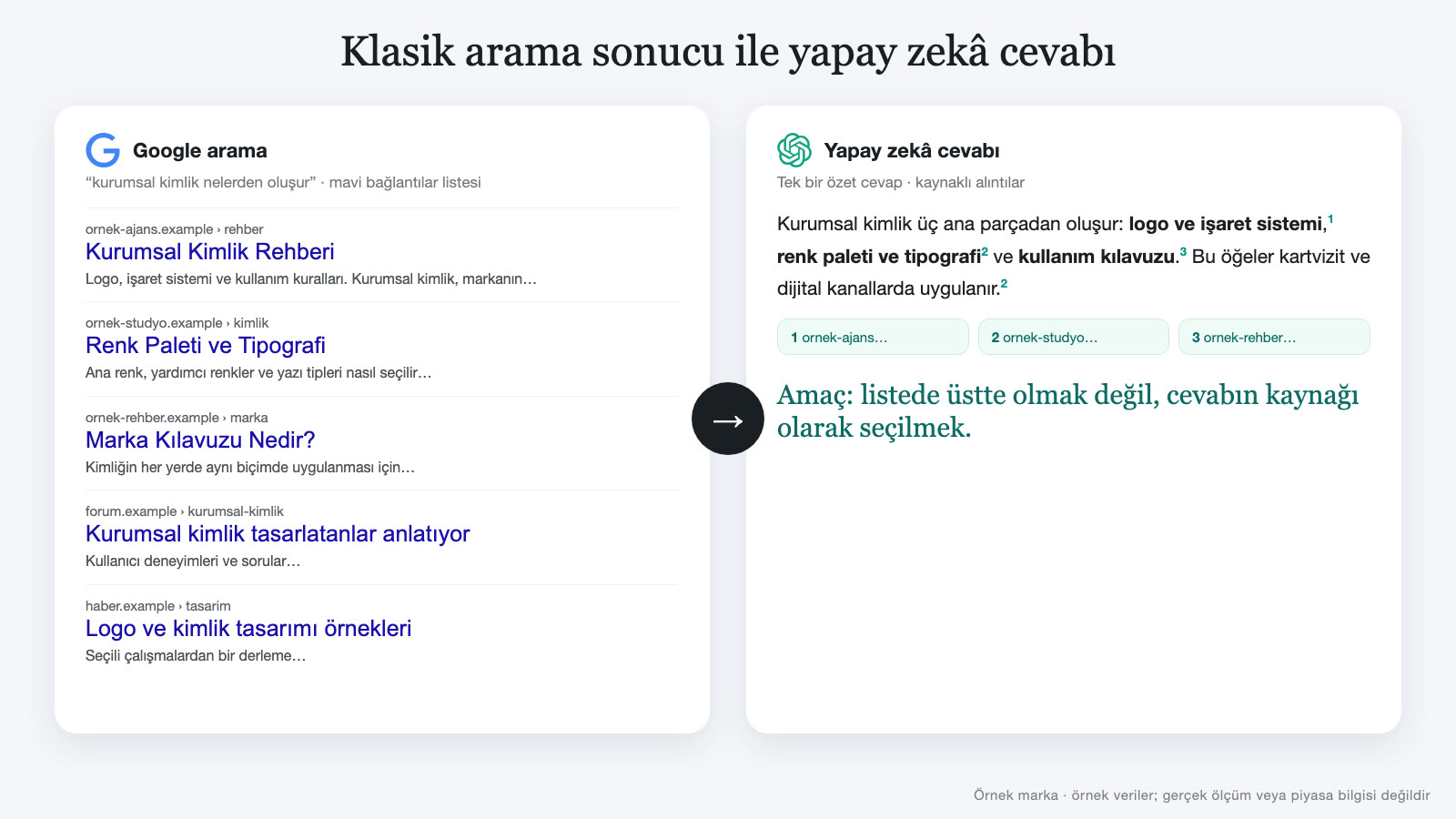
GEO is the abbreviation of “Generative Engine Optimization.” The term was introduced in the 2023 paper “GEO: Generative Engine Optimization” by Aggarwal and others as an approach that helps content creators increase the visibility of their content in generative engine answers. The paper’s abstract reports that, in the authors’ evaluation, GEO methods could increase visibility in generative engine answers by up to 40% and that the effect of these methods varies by domain; this is a result from the paper’s own experimental setup, not a guarantee for every site. In this article, GEO is used to mean work aimed at increasing the visibility of content in AI-powered search and answer systems.
Note: GEO in this article shouldn’t be confused with the “geo” prefix in geography or other fields; what is meant is GEO in the world of digital marketing and search.
Why is GEO on the agenda?
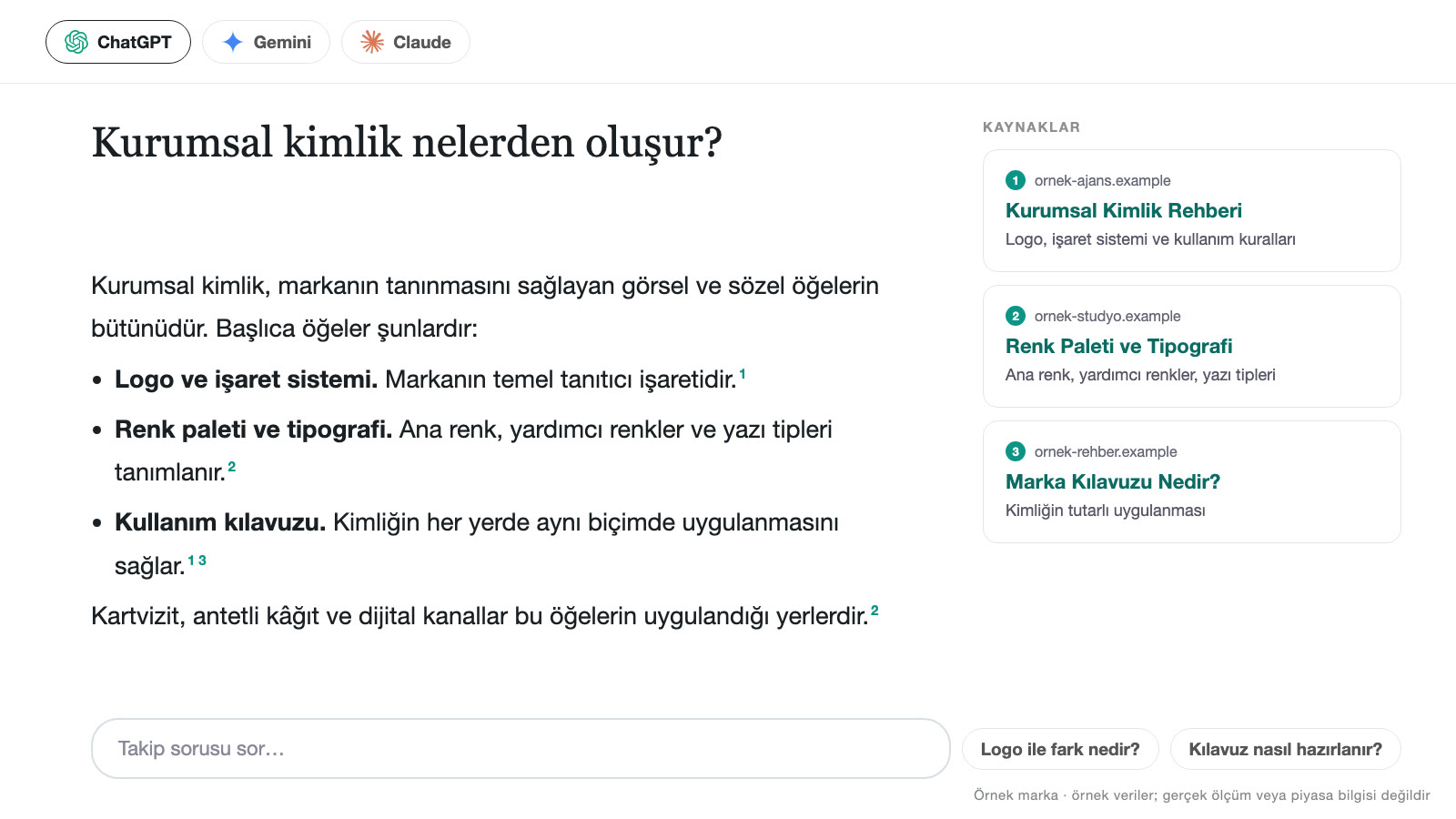
According to the paper’s description, generative engines answer queries by gathering information from multiple sources and summarizing it with language models; Google’s AI features documentation says that Google’s AI Overviews and AI Mode show links to supporting websites along with their answers. The possible consequences:
- Form of visibility: A page may or may not be shown as a supporting link in the answer.
- Clicks aren’t guaranteed: According to Pew’s data, clicking a link within the summary was rare (the figure below).
- Click rates: Pew Research Center analyzed browsing data from 900 US adults for March 2025: users who saw an AI summary on Google clicked a traditional result link in 8% of visits, compared with 15% for those who didn’t see a summary; clicking a link within the summary was seen in 1% of visits. These figures describe only this US sample and period; they can’t be said to apply to Türkiye.
- Which searches produce a summary: The same Pew study reports that searches with more words, that ask a question or that use full sentences tend to produce an AI summary (again a US sample).
The difference between GEO and SEO
The table below is Media Fish’s simplified comparison for telling the concepts apart; it is not sourced data.
| Feature | SEO | GEO |
|---|---|---|
| Goal | Appearing high in search results as a link | Being used and mentioned as a source in AI answers |
| Form of success | Ranking, clicks, traffic | Being mentioned, being cited as a source, being represented with accurate information, referred visitors |
| Keyword | Keyword and intent matching | Topic completeness, a direct answer to the question, and clarity of context and entities (brand, person, product) |
| Content format | Page-level optimization | Quotable, summary- and answer-focused, structured pieces |
| Measurement | Search Console performance report | Google says traffic from AI features is also included in the Search Console performance report; manual testing is also possible |
Google states that for a page to be shown as a supporting link in AI features, it must be indexed and eligible to be shown with a snippet, that there are no other technical requirements, and that SEO best practices also apply to these features. For the SEO fundamentals, see our SEO guide.
How are AI-powered answers produced?
The GEO paper describes generative engines as answering queries by gathering information from multiple sources and summarizing it with language models. Google’s AI features documentation says that AI Overviews and AI Mode may work with a “query fan-out” technique (running multiple related searches across subtopics and data sources) when producing answers, and that the two features may use different models and techniques. For how other systems work, see their own documentation.
The paper notes that generative engines are black boxes (their inner workings can’t be seen from outside) and fast-changing, and that content creators have very little control, or none, over when and how their content is shown. Google also says that even a page meeting all requirements isn’t guaranteed to be crawled, indexed or shown. For this reason, GEO is treated in this article not as a “definite formula” but as recommendations and sourced findings.
Practical GEO principles
The eight principles in this section are Media Fish’s recommendation framework; the effect of each has not been proven by a source. Sourced findings are given with their links. The paper reports that, in its experiments, adding quotations, sources and statistics could significantly increase source visibility, while keyword stuffing didn’t perform well (arXiv, full text of the paper); these results belong to the paper’s own experimental setup.
1. Give a direct, clear answer to the question
So that readers can easily find the answer to their question in the content, start the page or section with a short, clear answer (a definition, summary or conclusion), then give the details. Giving a two- or three-sentence definition in the first paragraph for “What is X?” and numbered steps for “How is it done?” is a good habit. The “In brief” box at the start of the posts on this blog is an example of this approach.
2. Credibility and citing sources
Support your claims with sources, give the source and date for figures, show expertise and experience (author information, about the business, references), keep the content up to date and avoid false or exaggerated claims. Google says it looks at which of experience, expertise, authoritativeness and trustworthiness (E-E-A-T) content demonstrates, and that trust is the most important among them (Google Search Central).
To create original value, it is recommended to add your own research, data, case studies, and real photos and experiences.
3. Structure your content
Structured content makes it easier for readers to scan the page. Google also lists having important content in text form among the SEO fundamentals.
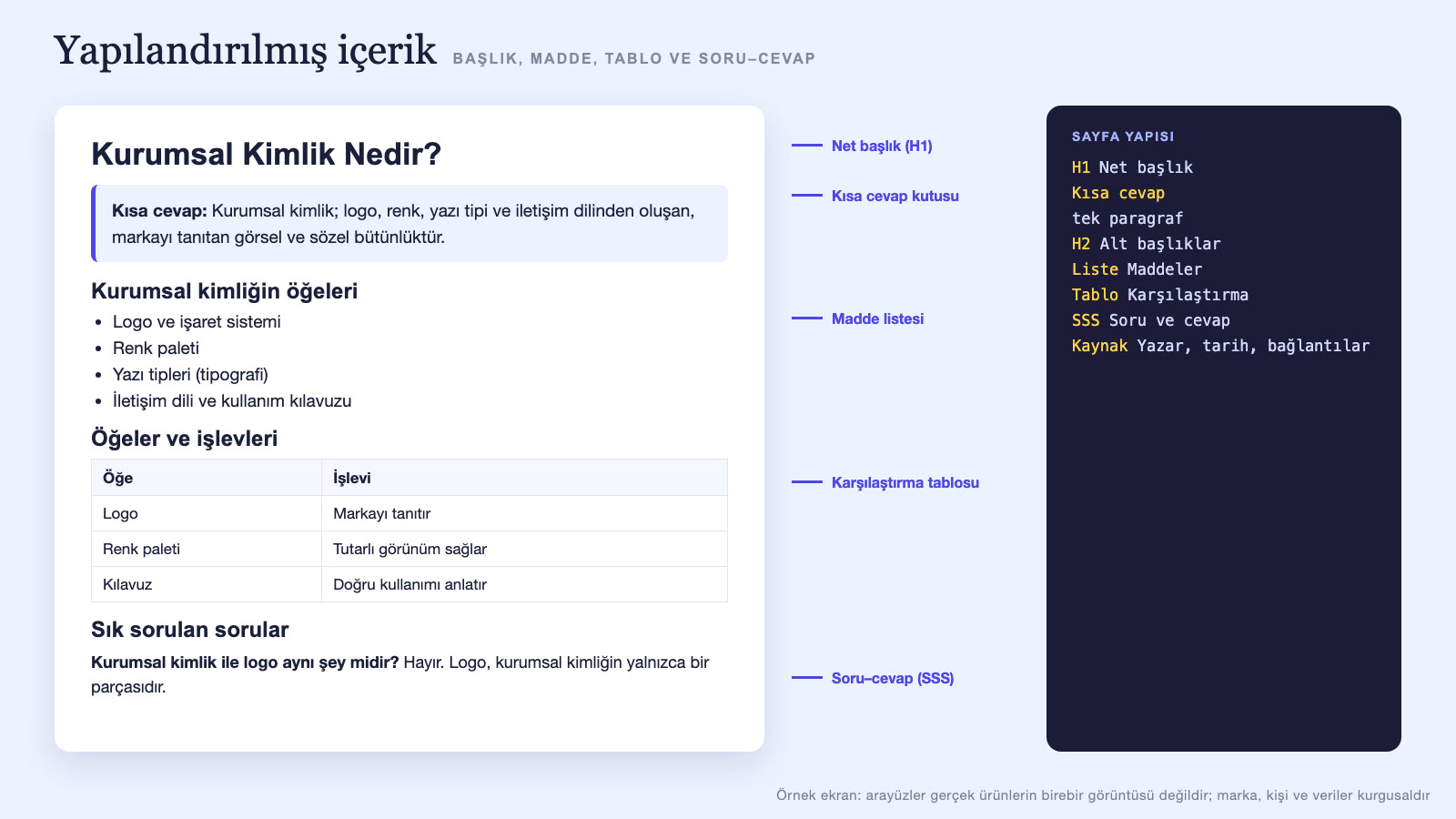
- A logical heading hierarchy: One main heading, then subheadings; let headings correspond to questions or topics.
- Short paragraphs and lists: Let each paragraph express a single idea; use bullets and tables for steps and comparisons.
- Question-and-answer sections: Write frequently asked questions as a clear question and a short answer.
- Definitions and glossary: Explain terms in one sentence.
- Summary boxes: A summary of the main points at the start or end of the page.
- Tables: Provide clear data for comparisons.
4. Structured data
Structured data (schema markup) is code that explicitly describes the content of a page (article, FAQ, product, business, person, event) to search engines and other systems. Used correctly, it clarifies the type of content and its relationships. Keep the markup consistent with the content visible on the page; adding invisible or misleading information violates Google’s structured data rules. In its AI features documentation, Google states that to appear in these features you don’t need to create new machine-readable files, AI text files or markup, and that no special schema.org data is required; Google also states that even a page meeting all requirements isn’t guaranteed to be shown.
5. Brand and entity clarity
Google’s AI features documentation lists checking that Merchant Center and Business Profile information is up to date among the SEO fundamentals. As a Media Fish recommendation, your brand’s name, what it does, where it is and who it is should be described consistently and clearly on the website, in business profiles, on social media and elsewhere. Write the About page clearly, add author and team information, write business details the same way on every platform (our Google Business Profile guide), and check the registration status and use of your brand name (our trademark guide).
6. Mentions and reputation across the web
This article presents no sourced data on the effect of mentions across the web on visibility in AI answers. As a general recommendation, real mentions such as news coverage, interviews and partnerships make your brand known; avoid creating fake reviews or bulk artificial mentions. Google’s structured data rules prohibit marking up misleading content such as fake reviews.
7. Technical accessibility
- Crawlability: Google lists making sure crawling is allowed in robots.txt and in the CDN or hosting infrastructure among the SEO fundamentals. Which bots you grant access to is a business decision; check each bot’s own documentation.
- Page experience: Google states that Core Web Vitals are used in its ranking systems (Google Search Central).
- Content in text form: Google lists having important content in text form among the SEO fundamentals.
- Internal links: Google lists making content easy to find through internal links among the SEO fundamentals. A sitemap can also be used to make discovery easier (recommendation).
- New file formats: Google states that to appear in AI Overviews and AI Mode, you don’t need to create new machine-readable files, AI text files or markup. For other systems, check their own documentation.
8. Freshness and maintenance
It is recommended to review important pages regularly, keep date and version information current and correct outdated information.
A page outline suited to GEO
You can structure the guide page you prepare for a topic like this, in a way that makes things easier for both readers and AI systems:
- Clear heading: A heading that reflects the question or topic itself and contains the phrase people search for.
- A short two- or three-sentence answer: At the very top of the page, the direct answer to the question (a summary box).
- Table of contents: A short list linked to the sections; it makes long content easier to navigate.
- Definition section: A plain explanation of the topic and key terms.
- Steps or main headings: Numbered steps, comparison tables, pros and cons.
- Example and case: A concrete example or real experience.
- Common mistakes and tips.
- Checklist.
- Frequently asked questions: Short, clear answers to real user questions.
- Sources, author and update information: Who wrote it, when it was updated and which sources it relies on.
This outline is Media Fish’s recommendation; it is not a sourced standard. The aim is for what each section covers to be clear from its heading and first sentence.
GEO for e-commerce and product pages
It is recommended that product pages carry clear information that can answer questions such as “Which product fits this budget and has these features?” Full product name and model information, technical specifications, size and material, price and stock status, use case and who it suits, comparison information, customer reviews and ratings, and return and delivery information. Google lists checking that Merchant Center information is up to date among the SEO fundamentals; it is recommended to enter product data (title, description, attributes, images) completely and consistently. Presenting product features in lists and tables is also a recommendation. For setup and product page details, see our e-commerce site guide.
Common misconceptions about GEO
- “GEO is a magic trick.” Google says no special optimization is needed to appear in AI features; there is no guarantee of results.
- “SEO is dead.” No. Google states that SEO best practices also apply to AI features.
- “AI-generated content has an advantage in GEO.” There is no sourced data in this direction. Google’s guidance says that producing many pages with AI tools without adding value for users may violate its spam policy.
- “It’s done once and finished.” The paper notes that generative engines are fast-changing; you are advised to keep your content up to date and monitor the results.
- “All AI systems work the same way.” Google says AI Overviews and AI Mode may use different models and techniques; the paper also reports that the effect of methods varies by domain.
- “Stuffing keywords works.” In the paper’s experiments, keyword stuffing didn’t perform well (this is the paper’s own experimental setup).
How should you prepare for the future?
This article doesn’t predict how AI-powered search and assistants will evolve; we don’t give unsourced predictions. Media Fish’s general recommendation: content that reflects real expertise and experience, accurate and consistent business data, a direct relationship with your own audience (email list, community) and following developments through official documentation. Not depending on a single platform or algorithm is also a risk management recommendation.
Content formats you can use in GEO work
The following list is Media Fish’s recommendation; the effect of these formats isn’t shown by a source (the experimental result on adding quotations and statistics from the paper is noted above).
- Comprehensive guides: Content that covers a topic from start to finish, divided into sections and with summaries.
- Question-and-answer pages: Pages that answer frequently asked questions based on real customer questions.
- Comparison and selection guides: Decision content such as “X or Y?” and “how to choose”; with tables and kept neutral.
- Definition and glossary content: Pages that explain terms clearly.
- Step-by-step methods: Numbered, clearly stepped instructions.
- Original research and data: Your own survey, analysis or case study.
- Expert opinions and quotations: Accurate, sourced contributions from named experts with titles.
- Multi-format content: Images, video and transcripts that support the text.
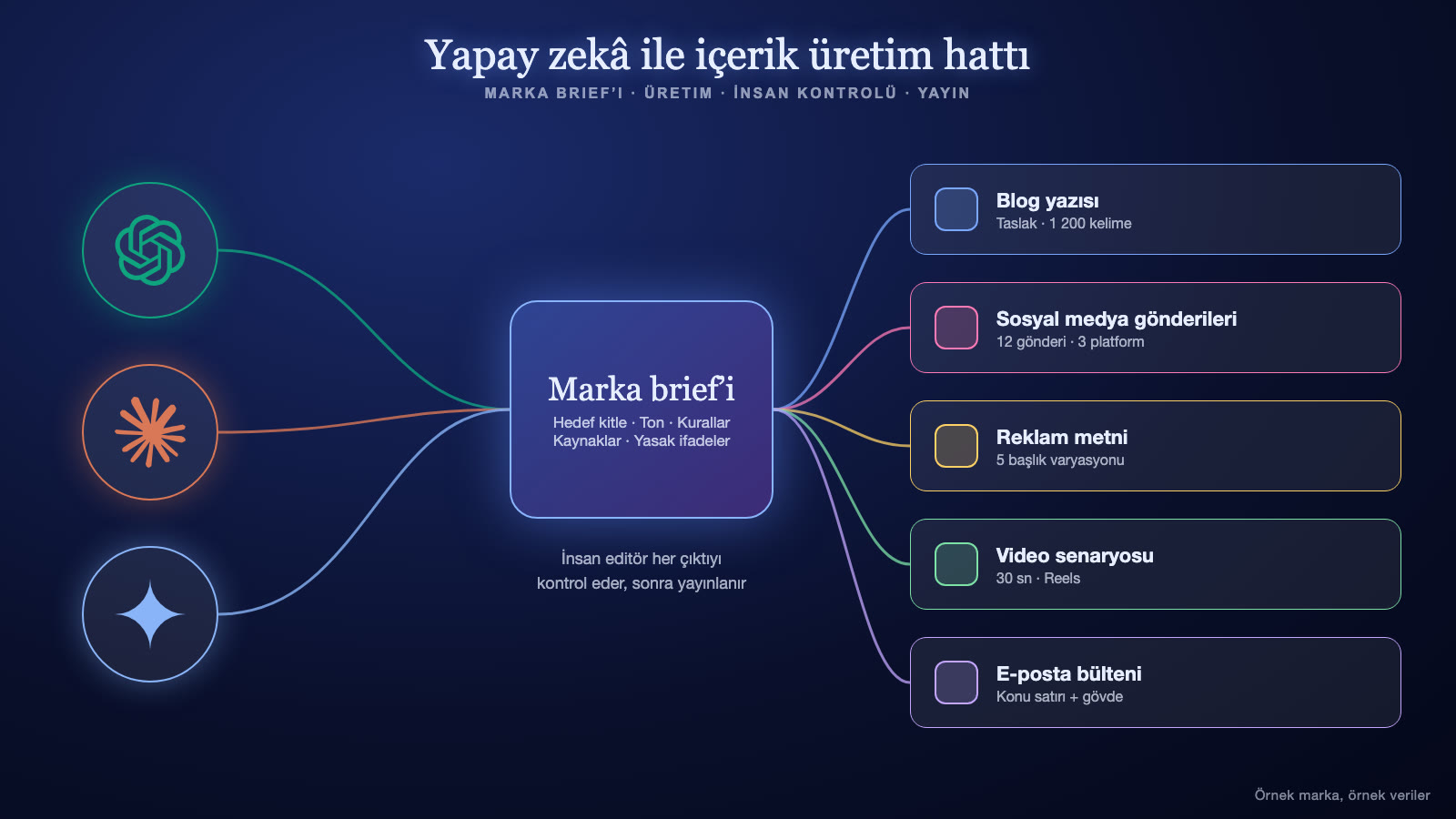
We covered accuracy and originality when using AI in content production in our guide to content production with AI.
GEO for local businesses
Google’s AI features documentation lists checking that Business Profile information is up to date among the SEO fundamentals. As a Media Fish recommendation for local businesses: fill in the business profile completely, write address and phone details consistently on every platform, prepare service and area pages on the website, answer frequently asked questions, and provide current photos and opening hours.
Measurement: How to track GEO
Google states that sites featured in AI Overviews and AI Mode are included in overall search traffic in Search Console and reported under the “Web” search type in the performance report. In addition, the following methods are Media Fish’s recommendations:
- Manual testing: Ask the key questions your customers would ask (your brand name, your services, competitor comparisons) in different AI assistants and search summaries; record whether your brand is mentioned, how it is mentioned and whether the right information is given. Because results can vary by person, time and system, repeat the test at regular intervals with the same questions.
- Traffic source analysis: In your web analytics, track referral traffic from AI-powered systems separately; the source information isn’t always clear.
- Brand searches and mentions: The number of searches for your brand name and the change in mentions across the web.
- Search Console data: Track which queries you get impressions and clicks for.
- Conversion quality: The behavior and conversion of visitors coming from AI systems.
- Accuracy tracking: If you see false information about your brand in AI answers, clarify your content and, where needed, send feedback to the relevant platforms.
It is recommended not to make decisions based on the result of a single test; Pew’s study also notes that summaries can change over time.
Risks, ethics and what to avoid
- Manipulation and tricks: Avoid methods aimed at fooling AI systems, such as hidden text, hidden instructions, fake reviews and bulk low-quality content. Google’s structured data rules prohibit marking up content that isn’t visible on the page and misleading content such as fake reviews; Google also says that producing many pages without adding value for users may violate its spam policy (Google Search Central).
- Promises of guarantees: Google doesn’t guarantee that even a page meeting all requirements will be crawled, indexed or shown; the paper also notes that content creators have very little control over how their content is shown. Be cautious with services that offer a “guaranteed top spot in AI answers.”
- Risk of false information: Generative AI outputs can contain inaccuracies (Google’s guidance); if you see false information about your brand, it is recommended to find its source, clarify your own content and keep it up to date.
- Content use and copyright: How AI systems use your content and under what conditions you grant access are commercial and legal decisions; keep following developments.
- Traffic expectations: In Pew’s US data, people who saw an AI summary clicked traditional results less often (the figures above); manage your click expectations accordingly.
The Regulation Amending the Commercial Advertising and Unfair Commercial Practices Regulation, published in issue 33297 of the Resmî Gazete (Official Gazette of Türkiye) dated July 1, 2026, took effect on August 1, 2026. Two of its provisions concern advertisements prepared with AI. The first (paragraph 8 added to Article 18 by Article 6 of the amending regulation): where AI or other software is used in advertisements in a way that significantly affects consumers’ economic behavior regarding a good or service, or where digital characters indistinguishable from humans created with AI technologies appear, this must be stated clearly, understandably and distinguishably. The second (paragraph 12 added to Article 27 by Article 11): advertisements cannot be made in which a digital replica of a real person, created with AI technologies, falsely gives the impression of having personally experienced or used a good or service, or makes a recommendation. For the exact text, see the Resmî Gazete page in the link.
Common mistakes
This list is a general framework for checking; it is not a ranking of measured frequency.
- Abandoning SEO: Neglecting the SEO fundamentals for the sake of GEO.
- Stuffing keywords or writing artificial text aimed at AI: Content that isn’t clear and useful for people.
- Approaching the question indirectly: Burying the answer under long introductions.
- Unsourced and exaggerated claims.
- Inconsistent brand information: A different name, address and description in different places.
- Producing content in bulk with no originality.
- Accidentally closing the site to crawling: Robot blocks and settings that hide content.
- Resorting to deceptive tactics.
- Neglecting measurement or relying on a single test result.
- Inflating expectations: Expecting definite results in a short time.
Example scenario: an accounting firm
This is a fictional example that isn’t based on a real client or a measured result. The clients of an accounting firm come with questions such as “Which company type suits a small business?” and “What are the tax obligations when starting an e-commerce business?” The firm wants to see how these questions are answered in AI assistants and in search summaries.
Current situation: The firm tests about twenty key questions across different assistants. As a result, the firm’s name isn’t mentioned in any answer; the answers use generic sources and a few large publications. On the site, service pages are short and generic, there are very few blog posts, and there is no author or expertise information.
Work done: Detailed guide pages are prepared for the ten questions clients ask most. Each page starts with a short, clear answer, continues with steps and tables, cites current legislation sources, carries a “last updated” date, and includes the name and expertise details of the certified public accountant. An FAQ section and suitable markup are added. The “About” page clearly describes the firm’s experience, service area and contact details. The Google Business Profile is updated and client reviews are collected. An article on choosing a company type is published in local business outlets.
Monitoring: The same questions are tested monthly for three months. In this fictional example, let’s assume that for some answers the firm’s pages are shown as sources and the brand is mentioned. Such a result shouldn’t be treated as a definite gain; it is only a signal to keep monitoring and keep the content up to date.
The changes in this scenario amount to good SEO and content work overall; the GEO perspective sharpens that work toward clear answers, sources and structure.
GEO checklist
- Are the SEO fundamentals (speed, mobile-friendliness, crawlability, titles and descriptions) solid?
- Do key pages start with a short, clear answer to the question?
- Is the content structured with headings, lists, tables and summary boxes?
- Are frequently asked questions written in a clear question-and-answer format?
- Are claims supported by sources and current dates?
- Are author, expertise and business details visible and accurate?
- Are the brand name, address and description consistent on every platform?
- Has suitable structured data been added, and does it match the content?
- Has access for AI and search bots been blocked by mistake?
- Are real mentions being earned in trusted places (news, publications, reviews)?
- Are key questions tested and recorded regularly across different systems?
- Are you sure tricks and guarantee promises are avoided?
If you want to run SEO and GEO work together with content, technical improvements and measurement, take a look at our digital marketing and AI services. You can also read our digital marketing guide for the general framework.
Mini glossary: GEO terms
- GEO: Generative engine optimization; the work of appearing as a source in AI-powered answers.
- Generative AI: A type of AI that produces new text, images or other content.
- LLM (large language model): A large AI model that can understand and generate text.
- AI summaries: Short AI-powered answers shown on search results pages (AI Overviews on Google).
- Source (citation): The page an answer is based on and that is shown.
- Structured data: Markup that describes page content to machines.
- Entity: A definable concept such as a brand, person, place or product.
- E-E-A-T: Experience, expertise, authoritativeness and trustworthiness; the name Google gives to the factors it looks at when evaluating helpful content.
- Hallucination: When a model produces false information as if it were true.
Frequently asked questions
What is GEO?
GEO (Generative Engine Optimization) is the work of increasing the visibility of content in AI-powered search and answer systems. Clear answers, sourced and structured content, and technical accessibility are the focus areas Media Fish recommends.
What is the difference between GEO and SEO?
SEO aims to appear high in search results as a link. GEO aims to be included as a source in AI answers. The two don’t conflict; Google states that SEO best practices also apply to its AI features.
Will GEO replace SEO?
This article makes no such prediction. Google says SEO best practices also apply to AI features and that no additional requirements exist.
How is GEO done?
Media Fish’s recommendation: Prepare content that answers the question clearly, is sourced and is up to date; structure it with headings, lists, tables and FAQs; add structured data that matches the visible content; keep brand and business information consistent; don’t put settings on the site that block crawling; and test the results regularly across different systems.
Can GEO guarantee a top spot in AI answers?
No. Google states that it doesn’t guarantee that even a page meeting all requirements will be shown. Be cautious with services that promise guarantees.
How are GEO results measured?
Regularly test your key questions across different AI systems and record whether you are mentioned and whether the information is accurate, track AI-driven referrals in your analytics, and follow brand searches and Search Console data. Don’t rely on a single result.
Conclusion
GEO aims to make sure your content and brand also appear accurately and reliably in next-generation answer systems, in a period when AI is changing the search experience. According to Google’s documentation, SEO fundamentals also apply to AI features; the paper reports that adding sources, quotations and statistics increased visibility in its own experiments. Based on these, our recommendation is to keep your SEO fundamentals solid, prepare content that is sourced and structured, manage brand and business information consistently, and measure the results. There are no guarantees; follow developments through official documentation.
This article was prepared with AI support. The images in the article are sample screens drawn with code; they don’t show a real client, person, place or data.
Related work
A few examples of Media Fish’s work on this topic:


E-Commerce Site + SEO + GEO
Design · Software · Publishing

E-Commerce Site + SEO + SEM
Design · Software · Publishing

Corporate Website + SEO
Design · Software · Publishing
Software Engineer, Media Fish. Writes on our blog about web and software, mobile apps, artificial intelligence and search engine optimization (SEO).